
Dresden, the state capital of Saxony, is one of the most dynamic cities in the region and could achieve growth of up to 6% by 2035 according to current population forecasts. While many regions in Saxony are confronted with declining or stagnating populations, Dresden benefits from a high level of attraction due to new settlements, a positive migration balance and a lively city life.
Particularly noteworthy is the increasing diversity of the population, which is boosting the city’s housing market and creating new opportunities for residential and commercial real estate. These developments underline Dresden’s potential as an attractive location with long-term prospects for investors and property owners.
Dresden has experienced impressive population growth in recent decades. Between 1990 and 2020, the population rose from 480,000 to 560,000. 2006 was a decisive turning point, when the birth surplus exceeded the death rate for the first time – a trend that continues to this day.
As of December 31, 2023, Dresden had 572,240 inhabitants, an increase of 3,067 people or 0.5 percent compared to the previous year. The proportion of foreigners reached a new high of 12 percent.
The population forecast of the city of Dresden expects an increase to around 603,400 inhabitants by 2040, which corresponds to growth of 5.9 percent.
In 2018, the age group of 28 to 38-year-olds was the largest population group, but is expected to shrink by 2035.
The number of 25 to 40-year-olds could fall by up to 16.2 percent.
The age groups aged 65 and over will increase and thus further drive the demographic ageing of the city.
Since 1990, the average age in Dresden has risen by 3.9 years and was around 42.9 years in 2018. An increase to around 43.4 to 44.1 years is forecast by 2035.
The gender distribution is currently almost balanced, with 49.8 percent male and 50.2 percent female residents.
Dresden’s population has been growing steadily for years. Various factors are making the city increasingly attractive for both residents and newcomers. Thanks to its economic strength, a wide range of educational opportunities and a high quality of life, Dresden attracts people from all over Germany and abroad.
Dresden is an important center for education and research, attracting young talent and skilled workers in particular. Dresden University of Technology, one of Germany's leading universities, as well as renowned research institutes such as the Max Planck Institute and several Fraunhofer Institutes characterize the cityscape and strengthen the region's innovative power. This academic environment not only attracts young people, but also contributes to the stability of the housing market.
Dresden has established itself as an important economic center with a strong focus on high technology and production. Known as "Silicon Saxony", the city attracts numerous companies from the microelectronics, IT and biotechnology sectors. International corporations such as Infineon and Globalfoundries have branches here and create well-paid jobs that attract highly qualified specialists to the region. As a result, demand for residential space - both for purchase and rental properties - remains at a consistently high level.
Dresden offers excellent transport connections, making it a particularly attractive location for commuters and business travelers. The city has an international airport, direct ICE connections to other major cities and a well-developed road and rail network. The various transport connections make it easy for residents to get to Dresden and neighboring regions quickly and conveniently. This mobility increases the attractiveness of real estate in Dresden.
Dresden offers an impressive variety of leisure and recreational opportunities that noticeably enhance the city's quality of life. The Great Garden, the green heart of Dresden, as well as the Elbe meadows and the nearby Elbe Sandstone Mountains offer ideal conditions for outdoor activities and relaxation in nature. The offer is complemented by the city's cultural highlights, including the world-famous Semper Opera House, the Frauenkirche and the State Art Collections, which captivate tourists and culture-loving residents alike.
The increasing demand for living space, particularly in the attractive districts of Dresden, is changing the real estate landscape and opening up new opportunities for investors and developers.
The continuous population growth in Dresden is leading to a steadily growing demand for real estate. This increase has led to a significant rise in prices on the real estate market. Statistics show that Dresden is experiencing particularly dynamic growth compared to other German cities. For investors, the market offers attractive opportunities for long-term increases in value. At the same time, potential buyers and landlords in central and up-and-coming districts can benefit from high yield opportunities. The increasing population has a positive effect on the entire housing market and underlines the stability of the region.
To meet the demand for housing, Dresden is stepping up construction activity and expanding its urban infrastructure. Between 2016 and 2020, around 2,000 to 2,500 new residential units were created each year, making Dresden one of the most active construction centers in Germany. This development offers investors and developers numerous opportunities to develop modern residential and commercial properties that meet the changing demands of a growing and diversified population. Family-friendly neighborhoods and barrier-free residential complexes in particular are in high demand and offer potential for future construction projects.
Dresden is undergoing a significant transformation that will shape the city’s districts individually until 2040. Forecasts show that districts close to the city center in particular, such as Pirnaische Vorstadt, Mickten, Friedrichstadt and Albertstadt, could experience strong population growth, with increases of up to 48 percent. This growth makes these districts particularly attractive for investment in residential and commercial real estate, as demand for modern living solutions and improved infrastructure will continue to rise.
At the same time, some districts, such as Prohlis-Süd and Gorbitz-Ost, are likely to see a slight decline in population density. This opens up particular opportunities for the reorientation and revitalization of these areas.
There are many opportunities for investors: not only to profit from the growth in high-demand neighborhoods, but also to contribute to the upgrading of less growing districts through strategic investments.

We accompany you!
Dresden is growing – use the potential! Our team is at your side with comprehensive advice and customized strategies.
The main factors driving growth in Dresden are positive migration balances, particularly due to immigration from abroad, as well as births and deaths. Economic development and settlements in the north of Dresden also play a role in encouraging additional immigration.
The birth rate in Dresden was relatively high until 2016, with a peak of around 6,429 births in that year. However, the birth rate has been falling since fall 2018. In mid-2023, the number of live births was 4,777. In the long term, the birth rate is expected to stabilize at 1.4 by 2035.
According to forecasts, Dresden will reach a population of around 603,000 in 2040. This development will be driven primarily by inward migration, as the birth rate has fallen in recent years and a birth deficit is still expected.
Forecasts up to 2035 indicate that districts close to the city center such as Pirnaische Vorstadt, Mickten, Friedrichstadt and Albertstadt will experience significant population growth.
October 2026
October 2026
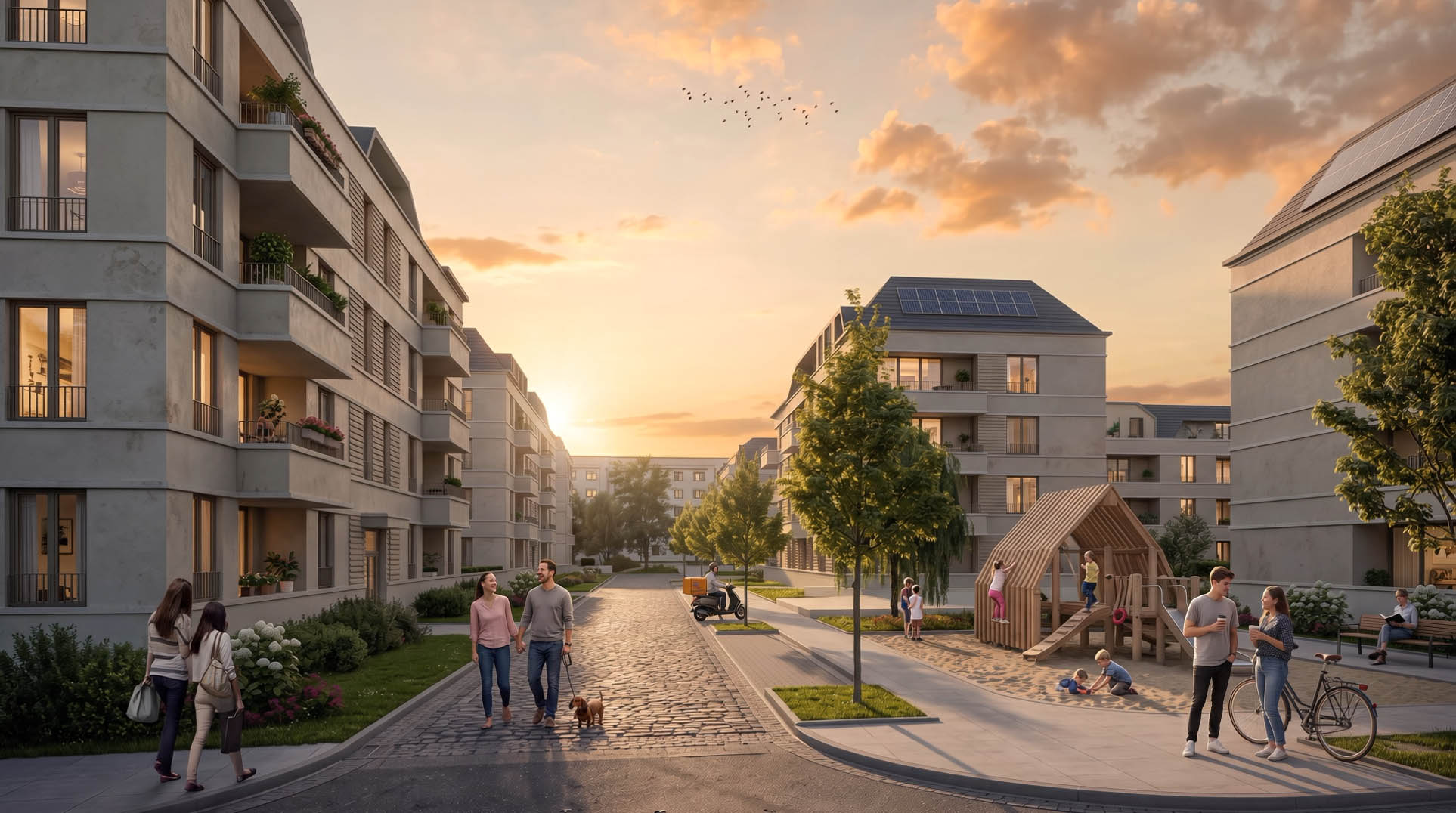
Come experience the Stadtgärten Dresden-Tolkewitz for yourself:
110 new apartments with 1 to 5 rooms, plenty of green space, and just a few minutes from the Elbe River. Our team will be happy to answer your questions in person. We look forward to your visit!
If you would like a free initial consultation, please register here:
You need to load content from reCAPTCHA to submit the form. Please note that doing so will share data with third-party providers.
More InformationYou need to load content from Turnstile to submit the form. Please note that doing so will share data with third-party providers.
More InformationYou are currently viewing a placeholder content from Vimeo. To access the actual content, click the button below. Please note that doing so will share data with third-party providers.
More InformationYou are currently viewing a placeholder content from YouTube. To access the actual content, click the button below. Please note that doing so will share data with third-party providers.
More InformationYou need to load content from reCAPTCHA to submit the form. Please note that doing so will share data with third-party providers.
More InformationYou are currently viewing a placeholder content from Facebook. To access the actual content, click the button below. Please note that doing so will share data with third-party providers.
More Information